Tue, 15 Oct 2002 21:24:05 GMT

Following on from my two Microsoft stories yesterday, Richard Bailey writes: “you’d think they (Microsoft) were the most incompetent and irresponsible marketers ever – judging from the many gleeful accounts of the pulling of the Apple switch ad (see Tom Murphy and Dan Gillmor for the background).”

Now maybe Richard has taken me up the wrong way but I don’t think Microsoft’s marketing is incompetent or irresponsible. I never meant to give that impression.

IMHO Microsoft are one of the most effective (product) marketing organizations on the planet. But Microsoft’s achilles heel is that they are very very agressive as an organism. And this agression has meant they have never fully replicated their product success in the corporate world and also is the driving factor behind blips like the faked Switch campaign. And there’s the rub ladies and gentlemen, its a fake. It was a mistake and they should be commended on their speed of correction but it doesn’t change the fact that it happened. It also doesn’t change the fact that in Microsoft’s most recent Marketing report they get two stars for the blogging program but lose one for the Switch episode.

For the record, many moons ago I worked on a Microsoft PR account and I have never before or since come across a more professional, passionate and effective PR machine. But let’s get some perspective, if I praise them when it’s right they should be knocked when it’s wrong. No one’s perfect. Just look at the spelling, grammer and waffle on this page…. [Comments]

Tue, 15 Oct 2002 01:28:42 GMT

So Microsoft is working with bloggers and gaining a competitive advantage. It’s legitimate and rewards their innovative marketing. But then they go and undo all that good work with sloppy, unimaginative and ill-advised tactics.

Apple�s Switch campaign � which I think is quite compelling advertising � is obviously annoying Microsoft.

And as I discussed last week, when companies feel threatened they do the oddest things.

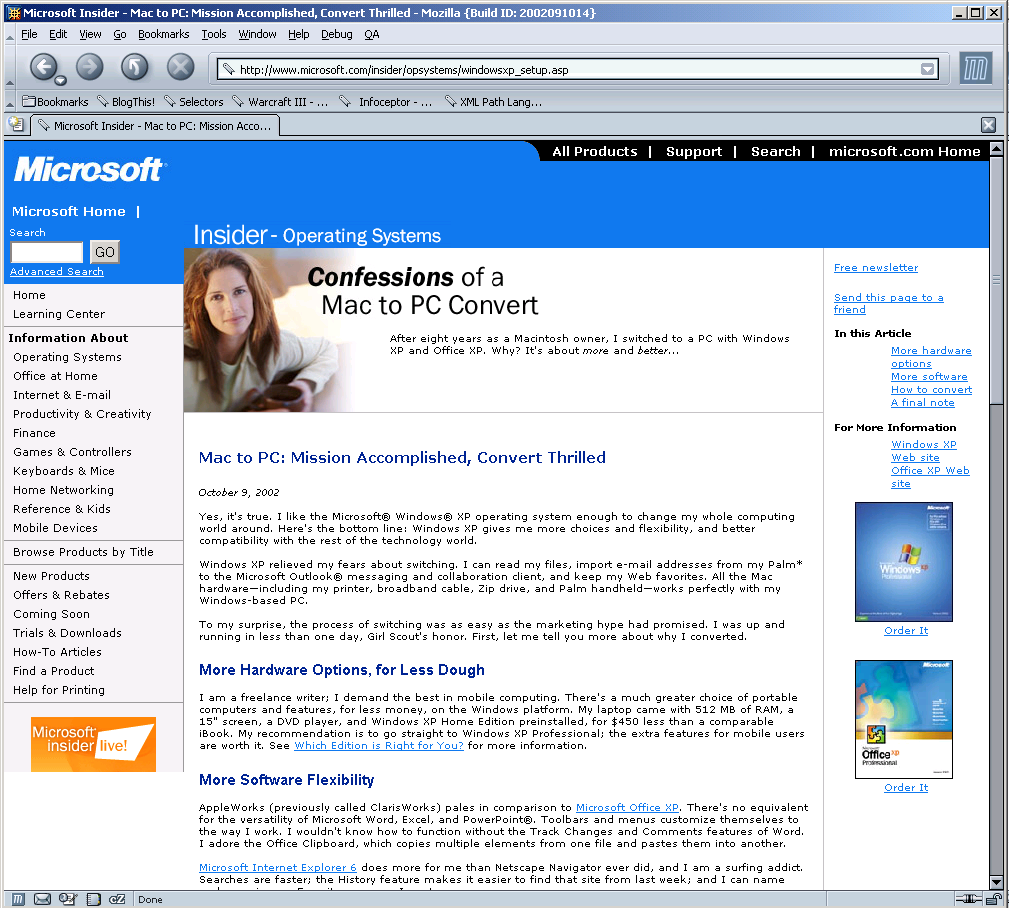
In this case Microsoft initiated their own “Switch” campaign – but of course this time it detailed Mac users who had switched to Windows.

One problem, they weren�t real users, they were Microsofties � using stock photography trying to pretend they were real people. Doh!

If the Internet has taught us anything, it has taught us that manufacturing untruths is a very very dangerous business.

Of course at the first sniff of trouble (They were rumbled on Slashdot) Microsoft removed the page, but the wonderful Google has cached it and Dave Winer has a screen shot!!

Tue, 15 Oct 2002 01:16:26 GMT

Microsoft is one of the most effective product marketing organizations on the planet. Full stop.

While it’s corporate marketing and public affairs activities can sometime err on the wrong side of agressive, their product PR machine is astonishingly effective. They monitor blogs in all their target markets and have a full proactive outreach program to the bloggers. Nick Denton points out just how fast Microsoft are.

Mitch Ratcliffe raises concerns that Microsoft will be able to exert undue influence on bloggers who don’t have the training to cut through the noise.

Doc Searls gives his, always readable, tuppence on the matter.

Tue, 15 Oct 2002 01:07:44 GMT

I�m sure you have by this stage heard about Ross Irvine�s latest missive on PR and the Internet. It�s been posted to every PR mailing list I�m on. Ross� focus is primarily focused on activism and NGO�s but it�s relevant to a wider audience.

Ross does make a lot of very valid points in the piece, entitled �PR Kittens� though sometimes I wish he would reduce the number of crass generalizations about how incompetent PR people are online. While I would agree our profession is not a stellar online performer, I find some of his views a little patronizing for my taste. However having said that, you could do worse than have a read of it, at the very least it�ll provoke a response. He has other opinion pieces on his site which are also worth a browse.

Tue, 15 Oct 2002 01:06:13 GMT

I read on the pages of O�Dwyer�s that Mediamap will no longer be using Bacon�s database and will instead replace it with its own media database.

Now you would think that for something this fundamental to their business that Mediamap would take a couple of minutes to inform their customers, wouldn�t you?

According to some colleagues who use the service, Mediamap haven�t said a word. These same customers were also disgruntled at Mediamap�s complete lack of communication over their new Performa product (a CRM for press relations) it seems that the only information on Performa has also been found in the trade pages, whilst the company has made little or no effort to brief paying customers.

No doubt they�ll be flabbergasted when subscribers leave their service. As I’m sure we’re all sick pointing out… a little communication is a good thing.

Tue, 15 Oct 2002 01:00:38 GMT

I have been a little slow posting over the past week as the day job has taken precedence – c’est la guerre….

Anyhow, there�s lots to catch up on with Microsoft showcasing the very best and worst of online communications, a new online piece on ‘PR and the Internet’ and a newly discovered UK blog and Mediamap’s great communications practices….

Wed, 09 Oct 2002 07:38:47 GMT

Well all that good news about PR spending increasing and clients loving their agencies – it was a little too good to be true, wasn’t it?

These days we all expect the worst. Hot on the heels of the demise of the Hurwitz Group, Upside magazine has closed it’s doors (Thanks to Phil Gomes for the link) as has Mutual Funds magazine.

Mutual Funds magazine isn’t a shock to anyone, I mean it might as well have been titled “Setting up your dot com business monthly”, but Upside had been through some bad times and seemed to have managed to come out the far side. It’ll be missed. The website’s still online, visit while you can.

Mon, 07 Oct 2002 19:57:23 GMT

If you look at any group of children, for the most part, they are happy in each other’s company. They play, they chase and they will generally amuse themselves happily. However, once they become intimidated, worried or frightened, things change. Once they’re uncomfortable they try to put things right by deflecting their fear onto someone else and before you know it they are accusing someone that “my daddy is bigger than yours“.

Now you might be wondering why someone so absolutely unqualified and inexperienced as I in matters of child affairs is attempting to unravel the mystery of childhood, but there is a lesson for all PR practitioners in there. Bear with me!

Companies who aggressively target their competitors through their marketing are letting themselves down. They are saying to the world, “all is not well here”, worse they are telling the world they are afraid of their competitors – and they are taking the time (and money) to point those competitors out to their potential customers.

That’s not to say it’s always the wrong strategy. In carefully planned circumstances a smaller player can get excellent mileage from some well aimed arrows at a larger, incumbent vendor. But on the whole, IMHO it’s a strategy to be avoided.

Of course scaremongering is not a tactic exclusively reserved for client companies. I am often amazed at the number of PR agencies who openly diss their competition in pitches and even in social settings.

The first thing I do following one of these outbursts is go and talk to the other agencies, because they are obviously doing something right to draw such vitriol!

So here’s the message: Focus on what you and your firm or client do well. Deliver on that and you’ll be closer to succeeding. [Comments]

Thu, 03 Oct 2002 17:54:16 GMT

Following the Thomas L. Harris study that found PR budgets climbing again, the Patrick Marketing Group have also released favorable research. According to their survey on marketing budgets (which interviewed 250 executives) the number one sales & marketing action to be implemented in the next twelve months is PR, followed by direct mail, e-marketing, tradeshows and advertising. 71 percent of those surveyed quoted PR. In other findings, 49 percent of respondents expected their marketing budgets to be bigger in 2003. So it’s not all bad news 🙂